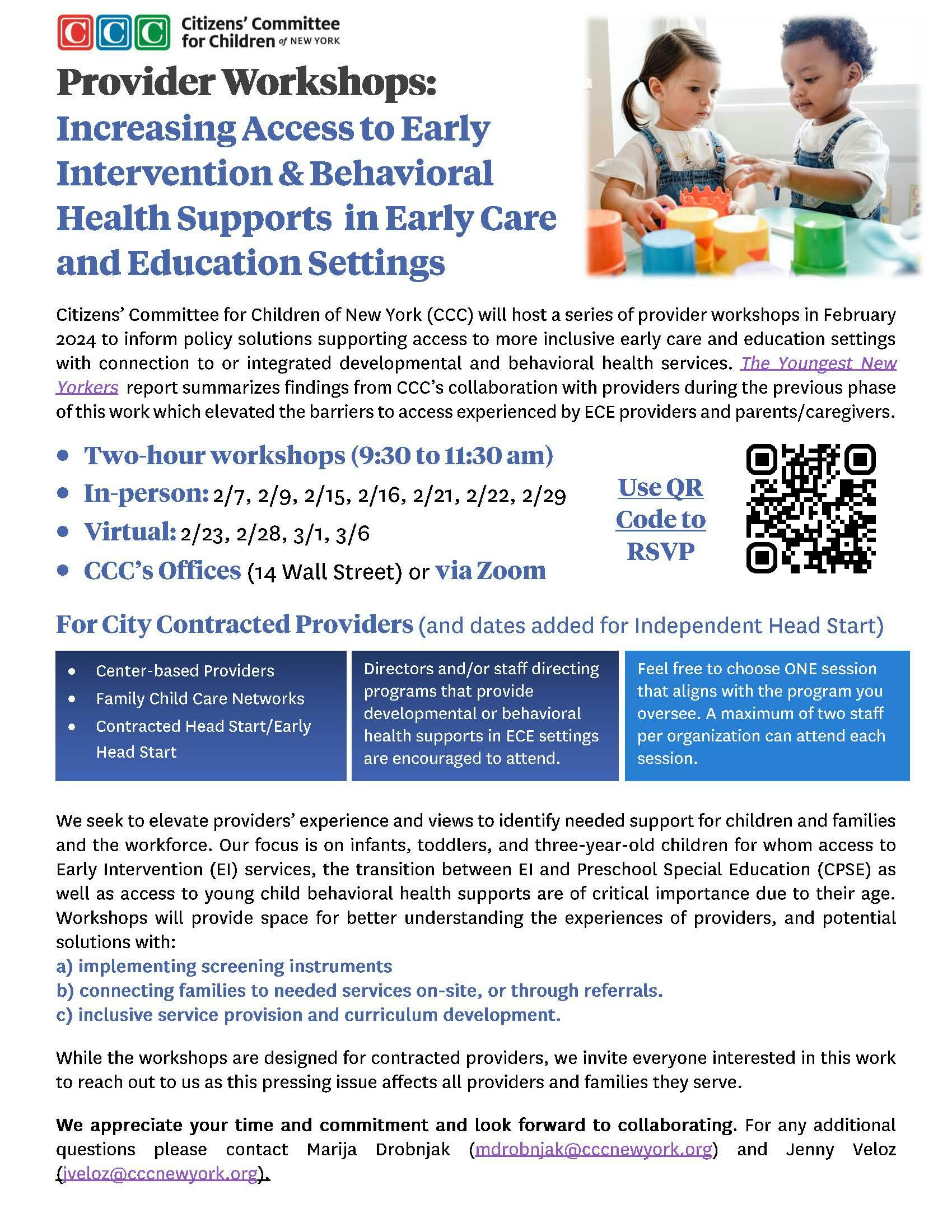
Increasing Access to Early Intervention and Behavioral Health Supports in ECE Programs
Digital Briefs
February 21, 2024
As part of CCC’s ongoing efforts to improve access to early care and education (ECE) services (child care for children under 5) in New York City, we are undertaking qualitative research to improve connections to Early Intervention (developmental needs services) and Behavioral Health services for young children within ECE settings (community-based centers and family child care providers). This research project builds on the work we have undertaken over the past two years to collaborate with NYC ECE providers and parents/caregivers to identify policy solutions that address the issues families of young children face in finding and accessing comprehensive, affordable, and sustainable early care and education services.
Our research has demonstrated that center-based and family childcare service providers are the backbone of New York City’s early care and education system and trusted by families across NYC communities. Unfortunately, our research also underscores that providers are very under-resourced and face multiple operational and workforce challenges in providing essential services to children and their families. At the same time, families have elevated concerns about rising behavioral health needs for caregivers and children and the multiple barriers they face in accessing a wide range of developmental and behavioral resources in their communities.
Provider Workshops for the Project
CCC is hosting a series of provider workshops early in 2024 through which we seek to elevate providers’ experience and views to identify needed support for children, families, and the workforce.
If you are an ECE provider interested in participating in an upcoming workshop, please click here to register. For more information see this Flyer and share with colleagues/partners that might be interested.
New York City Department of Education requires all contracted ECE providers to conduct developmental screenings and provide needed developmental or behavioral health services either in their settings or through referrals, for children in their care. From these workshops, we hope to gather input from publicly contracted ECE providers serving infants, toddlers and three-year-olds for whom early access to Early Intervention (EI) services, Preschool Special Education (CPSE), and other developmental and behavioral health supports are of critical importance due to their age. We hope to collect information from contracted centers, Head Start and Early Head Start providers and Family Child Care Networks on their experiences leveraging screening instruments to guide curriculum development, on site services, and screening referrals. We also hope to gain insights from providers on the screenings for EI and BH services and how they inform curriculum and programming, inclusivity of services provided on site and referrals to offsite services.
These workshops will also help identify successful practice among providers and to elevate the most common challenges that providers experience in navigating the nexus of different services and supports across the continuum. The workshops will work to identify challenges that providers across all systems face in inform opportunities for system level change.
- Elevating the most common challenges that providers experience in navigating this nexus of different services and supports across the continuum (better understand the screenings and how they inform curriculum and programming, inclusivity of services provided on site, referrals to off-site services, etc.).
- Identifying workforce challenges that providers across all systems face to inform solutions within and across Early Care and Education, Early Intervention and Behavioral Health.
- Identifying opportunities for system-level change to improve access to developmental and behavioral health services within ECE settings.
- Identifying successful practice among providers related to how developmental and behavioral health services are either integrated in the ECE programs or connected to through providers outside of ECE settings.
Through our previous work with providers and parents, we identified a growing need for local policies and investments that would improve connections to Early Intervention and behavioral health services within ECE settings to address children’s developmental and social-emotional needs. Providers discussed solutions including integrating staffing and services into ECE program settings and facilitating warm handoffs to external services providers when needed.
In this new phase of qualitative research, CCC seeks to engage experts from ECE programs, as well as young child behavioral health providers, EI providers, and other partners that offer essential services in or through ECE settings whose knowledge and expertise of early care and education services, infant and young child development, and other essential services for families with young children. Along with providers, CCC will identify best practices that currently exist in programs that could be expanded on, as well as the budgetary and policy solutions that would address challenges that providers currently face in integrating these programs or initiating referrals.
What we know about access to Early Intervention and Behavioral Health for Young Children in NYC
The Early Intervention system has faced decades of underinvestment, which has resulted in widespread provider shortages, delayed services, and inequities in access. Low reimbursement rates are driving providers out of the program, leaving infants and toddlers waiting for and at times denied developmental services because no provider is available. Children continue to wait weeks, sometimes months, for the in-person services they need. As a result, they are falling behind their peers in developmental growth. Even when a child is identified in an ECE setting as having a developmental need, the shortage of EI providers contributes to the challenges families face in finding and receiving timely Early Intervention services.
In New York, our health system doesn’t have the capacity to treat the skyrocketing number of kids desperately in need of mental health support. Right now, children often have to get really sick to get help, and that help is too often delivered in emergency rooms and hospitals, rather than through the ongoing, high-quality services they need to stay healthy. Unfortunately, New York has not invested enough resources in the children’s behavioral health system to pay for the true cost of serving children or to provide high quality care to every child. As a result, providers across the state are facing severe workforce shortages, and families are left struggling to find urgently needed care. Within ECE settings, there are additional barriers to connecting young children with behavioral health settings. These include but are not limited to: A shortage of providers trained in how to offer supports to young children; too few bilingual and BIPOC providers of young child mental health; lack of payment models and local, state, and federal funding to support integrating early child mental health providers in ECE settings; a lack of integrated services across settings and agencies; and difficulty providing parents/caregivers with their own mental health services in these child-serving settings….
Learn more about our research in ECE, EI and BH!
Early Childhood Education
Findings from our analysis of enrollment and capacity data, as well as conversations with ECE providers, and a citywide survey of parents and young children are summarized in a report, The Youngest New Yorkers: Building a Universal Early Care and Education System in New York City.
Our more recent data analysis, (Un)Affordability of Child Care and Out-of-School Care in NYC, further reinforces the need to strengthen the publicly funded ECE system to allow providers to offer high quality care for children in NYC.
Early Intervention
As mentioned, children throughout the city have been unable to receive timely and comprehensive developmental services due to provider shortages and a chronically underfunded Early Intervention system. To understand the impact of delayed EI services, CCC put together an Early Intervention fact sheet in 2023 with data on delays, referrals, and evaluations. Click here to read the factsheet. You can also read an overview of the factsheet details in the context of budget advocacy in this Insight from last year, Less Than Half of Children Receive All EI Services On Time.
Behavioral Health
CCC is also part of the Campaign for Healthy Minds, Healthy Kids (HMHK) as a leader and co-convener. The HMHK website has ample information about New York’s behavioral health crisis and advocacy around increase investments in the continuum. Click here to learn more and download an infographic.